Decisions
In the center of the immigration debate there is this fundamental idea that doesn’t get explicitly talked about much. Maybe it’s too central, too obvious, too inherent. As a country that millions of people want to move to-we get to pick who comes here.
The debate is usually couched in terms of being for immigration or against it, but all countries and most people support some limit on the number of immigrants. As long as there is a cap, there will always be more people who would like to come, but can’t. In 2015 the US issued about a million green cards. 50,000 of those were under the diversity lottery, a program that gives green cards to migrants from countries which typically don’t send many immigrants to the US. The number of qualified applications for the 50,000 slots, was 9.3 million.
Which means that there must be a way to decide who gets to come in and who doesn’t.
Motivation
This is not easy. People migrate for all sorts of reasons: economic opportunity, family ties, escaping war and oppression. Governments also have all sorts of reasons to encourage immigration: population growth, attracting workers, supporting refugees, encouraging multiculturalism and a diverse society. The ‘who to prioritize’ question is a deep question because it says something about what the society thinks is important.
There are lots of countries that have to make this decision, and they have different ways of doing so. For skilled workers, Canada has a points based system, and those who score highly (younger people, those with more education, strong skills in English or French, and more ties to Canada) are prioritized.
The US basically breaks down its permanent residency visas (green cards) into four categories: those joining family members, those coming to work, refugees, and a fourth category that is designed to attract migrants from countries that typically see low amounts of US migration.
Most of these categories are broken down into subcategories. In most of instances there are caps on the number of people admitted to both the subcategories and the larger categories. There is no cap to the number of immediate relatives (children, spouses, and parents) of US citizens that can enter each year. The second largest category, which includes the extended family of US citizens, plus the family of permanent residents, is capped at 226,000. The cap on employment based green cards is 140,000.

Waiting
An applicant might have an easy time or a hard time depending on where they are from and which visa category they qualify for. The variation is partially caused by a cap on migrants from each country. A maximum of 7% of employment and family visas are issued to immigrants from any given country. This cap is not adjusted for either the population, nor the number applicants, of the country. As a result there are long wait times for those coming from countries with a lot of applicants.
For those applying in a category with more applicants than spots there is a waitlist. The waiting time can vary massively, from no wait at all, to years. For Mexican adult children applying to join their citizen parents, the wait time is over 20 years. For Indian workers without a graduate degree it is over ten. Alternatively, anyone who meets the requirements of the most exclusive employment category, priority workers, can come right in.
Citizens of countries that typically see fewer migrants, are eligible for the Diversity Visa program which gives out 50,000 green cards each fiscal year, via a lottery. It only takes the equivalent of a high school education or two years of work experience to qualify, but a tremendous amount of luck to get a visa. In 2015 nearly 10 million people applied for the 50,000 spots.
Employment Based Immigration
As in most countries, one goal of US immigration policy is to encourage workers to come to the US and engage in work that will benefit both US employers and the US economy in general. In nearly all cases, employment visas require sponsorship from an employer. Among other things, this means that, at least for non-temporary workers, an employer must first prove they cannot hire an American for the role in question (a process called Labor Certification).
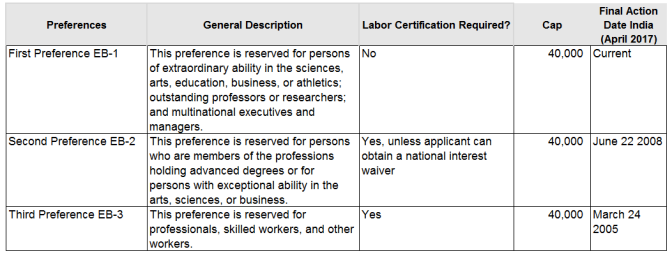
The core of this table is here. Final Action Date, is the most recent application date that is available for Visas. India was chosen due to its long wait lists for EB visas.
Applicants for employment based green cards apply in one of five categories (with the first three being the most prevalent and shown above).
The first category, EB-1 includes persons of extraordinary ability[1] such as those who have won Olympic Medals, been awarded Oscars, or are otherwise notable in their field. Unlike most employment visas, these people do not need labor certification. Also eligible for EB-1 are prominent professors and business executives although these people do require labor certification.
The second preference is for those with substantial work experience, advanced degrees or other high qualifications. The third preference is for those with Bachelor’s degrees, skilled, and unskilled workers. Even though the category for skilled workers (EB-3) is much broader than the other two, the same number of visas 40,000, are reserved for each subgroup. This is the primary way the US prioritizes which workers it will allow to become permanent residents.
There is a similar system for temporary workers, in which workers are categorized and a certain number[2] from each category are accepted. There are separate categories for skilled and unskilled workers. These have some quirks, the skilled worker (H-1B) category, also includes fashion models “of distinguished merit and ability”, along with other skilled occupations. Workers with master’s degrees have a better chance at a visa than those that do not. There are separate visa categories for occupations like artists and athletes.
Luck and Haste
Foreign workers face a more awkward hiring process than other workers. After the traditional job search process is done and the company finds a worker who they would like to hire, they submit the paperwork sponsoring the worker to US Customs and Immigration.
If there are more applicants in the visa category than there are available visas, and there probably are, there is additional uncertainty. While there is a waitlist for green card applications, there isn’t one for temporary work permits. Depending on the number of applicants and the type of visa, there may be a lottery or visas may be awarded on a first come, first serve basis. Contingent on their luck or haste the worker might or might not get in.
This is all rather crude. If the company would like to employ multiple foreign workers, some of them might get in, some might not. The company has no mechanism to express which workers are more important to them, and within the category there are only limited mechanisms (such as visas reserved for workers with master’s degrees) for differentiating between workers.
Highest Bidder
[I first came across this idea from Giovanni Peri, in this planet money show. He has also written about it here and here.]
The right to employ a foreign worker is a resource that has been made scarce by imposed caps and limitations. Most scarce resources are allocated by markets. Market allocation works better for some things (say toasters) than others (say healthcare), but for foreign workers it would almost certainly work better than the current system.
Visas would be auctioned each year to those companies who wished to hire a foreign worker. At least initially this would involve two separate auctions that would take the place of the current distribution system of H1B (skilled) and H2 (unskilled) temporary work permits.
The proposal allows for companies to submit a sealed bid with the amount they would be willing to pay for the right to hire a foreign worker. If a bid was selected, the worker would get a temporary work permit, which would allow them to work in the US for three years[3], and employers would receive a permit allowing them to hire a foreign worker. The foreign workers would not be obligated to remain with the employer who had paid for their permit, but would be allowed to work for any company that had the appropriate permit to hire foreign works.
It would almost certainly be a more efficient system than the current one. The chief advantage is providing a mechanism that allows differentiating among potential workers, depending on how much their skills are valued by employers.
There would be other benefits as well. The most obvious one is revenue, this program could bring in around a billion dollars[4] in revenue each year. Auctions would provide information on where foreign workers were most valued, and where the US workforce was lacking. If nearly all the visas went to software developers and economics bloggers, it would be obvious that there was a deficiency in these professions. Since there was a price attached to this discrepancy it would be possible to see the magnitude of this gap, as well as how it changed over time.
Not for everyone
Of all the reasons a country might wish to attract immigrants, hiring foreign workers, especially temporarily, is probably the most selfish and mercantile. Unlike the immigration of refugees and the family of current residents, which are linked to ideals of helping and togetherness, importing foreign workers is much more like importing anything else we need but don’t have domestically.
To be certain, a lot of the benefit goes to the workers themselves in the form of huge wage increases relative to what they would make elsewhere. The company that employs the worker, also benefits, as they now have a productive worker they couldn’t otherwise have.
While it would undoubtedly be a mistake to conduct all immigration via the highest bidder, for temporary workers (and maybe employment based green cards?) it seems absolutely appropriate.
Let the wealthy in?
It is not obvious exactly what sorts of workers would be prioritized under this system, but they would probably be the most well-paid of the current crop of applicants. Prioritizing the most highly paid forign workers might seem antithetical to the spirit of opportunity that is associated with immigration. However, merely by having a relatively small cap on the number of legal immigrants and temporary workers, the United States already prioritizes immigrants who already have significant skills and opportunities. We just do it crudely.
If the goal is to provide immigration opportunities to a diverse pool of applicants, the best way to do this is not through the skilled worker program, but to increase the overall number of legal immigrants, modify the country caps, and expand programs like the diversity lottery. If one is concerned about giving away immigration status to the wealthy, a better target is the EB-5 Program which offers permanent residency to those who invest $1,000,000 in a US business.
No line to wait in
No country allows unrestricted immigration. Countries that cap immigration will always be forced to prioritize the admission of some immigrants over others. How to best do this will always be a complicated question, impacting who migrates through both official and unofficial channels.
The US does get to decide who gets to come legally, but it doesn’t always get to decide who comes in. Currently, a Mexican worker with no family in the United States and a high school education, has basically no way to legally migrate to the United States. It is not even a matter of enduring a long waitlist, there just isn’t a category to wait in.
In a time of wall construction and travel bans, it might seem like there are more important immigration topics than a couple year-old, wonky, tweak to a part of the immigration system that impacts a relatively small percentage of immigrants, and there probably are. I find the idea of selling work permits interesting not so much because it will solve all our immigration issues, although I think it would be an improvement, but because it makes me think explicitly about how we go about deciding who to let in and who we don’t. Any serious conversation on immigration should start there.
Sources, References, and Further Reading
US Customs and Immigration Services
https://www.uscis.gov/working-united-states/permanent-workers
https://www.uscis.gov/working-united-states/permanent-workers/approval-and-denial-statistics-i-140-immigrant-petition-alien-workers
Visa Categories, wait lists, and caps
https://www.americanimmigrationcouncil.org/research/employment-based-visa-categories-united-states
https://travel.state.gov/content/dam/visas/Statistics/Immigrant-Statistics/WaitingListItem.pdf
https://www.quora.com/Is-the-waiting-list-for-U-S-Green-Cards-7-years
https://travel.state.gov/content/visas/en/employment/temporary.html
https://travel.state.gov/content/visas/en/law-and-policy/bulletin/2017/visa-bulletin-for-april-2017.html
Employment Certification Form
H1B Occupations
News and Media
https://www.nytimes.com/2017/03/01/us/politics/immigration-trump.html?smid=tw-nytimes&smtyp=cur&_r=0
http://www.economist.com/blogs/democracyinamerica/2011/05/immigration
http://www.npr.org/sections/money/2017/02/08/514152963/episode-436-if-economists-controlled-the-borders
https://www.bloomberg.com/view/articles/2017-03-24/immigrants-are-making-the-u-s-economy-stronger
http://www.pewresearch.org/fact-tank/2015/10/05/todays-newly-arrived-immigrants-are-the-best-educated-ever/
http://news.nationalgeographic.com/news/2013/06/130630-immigration-reform-world-refugees-asylum-canada-japan-australia-sweden-denmark-united-kingdom-undocumented-immigrants/
Selling Work Permits
http://economics.ucdavis.edu/people/gperi/
http://www.slate.com/articles/business/moneybox/2012/02/auctioning_residency_permits_could_raise_a_lot_of_money_and_solve_the_illegal_immigration_problem_.html
http://www.npr.org/sections/money/2017/02/08/514152963/episode-436-if-economists-controlled-the-borders
Brookings
http://www.scpr.org/blogs/multiamerican/2012/05/17/8262/work-permits-and-auctions-a-look-at-two-new-propos/
Hoover
Statistics and Data
http://www.ncsl.org/research/immigration/us-immigration-snapshot-2011.aspx
https://www.dhs.gov/immigration-statistics/yearbook/2015
http://www.npr.org/templates/story/story.php?storyId=5404217
FOOTNOTES
[1] There are categories for both persons of extraordinary ability which is a subcategory of EB-1 and persons of exceptional ability which is a subcategory of EB-2. Persons of extraordinary ability is the better one to be in. Obviously.
[2] There are some uncapped categories such as temporary agricultural workers.
[3] one year for those receiving the equivalent of H-2 visas.
[4] Or, measured another way, about 1/20 of the cost of the proposed border wall.
Relevant PARTYSHEEPHATS posts
Where should you move if you want to qualify for the Olympics, but aren’t good enough?
Not Relevant PARTYSHEEPHATS posts
Why are airfares so volatile?
Should we get rid of the $100 Bill?






 partysheephats