How Much Would a Universal Basic Income Cost?


What do Mark Zuckerberg, Martin Luther King, and Milton Friedman all have in common?

That’s right, they are all famous Americans whose names begin with the letter M.

Also, they are all proponents of some form of basic income.

A Universal Basic Introduction


The universal basic income (UBI)  [1] has become trendy.  It is the ultimate unconditional cash transfer. Each member of a society gets a cash payment. Since it’s given in cash, there are no restrictions on what this payment should be spent on, nor are there restrictions on who gets it. Rich and poor get the same amount, regardless of their income.

Sounds nice. It probably is. A basic income could alleviate poverty, reduce inequality, be more efficient than our current welfare system, and provided greater freedom and autonomy for recipients.

It also sounds expensive.

A Note:  UBI and the Minimum Income

Related to the basic income is the concept of a minimum income. A minimum income provides an income even if someone has no other source of income.  Unlike the universal basic income, it phases out as income increases, though never sharply enough so that it is not beneficial to have market income.

There are certain tax structures that, combined with a basic income, have equivalent redistribution impacts as a minimum income. For this post, I’ll be examining the universal basic income, trying to figure out how much it would cost, and how to pay for it.

$12,000

I’m going to assume that the basic income would give every American over eighteen $12,000 and those under eighteen $4000 a year. These are about the amounts that define the federal poverty line, and most of the examples of an American basic income I’ve seen use numbers around this. One nice feature of giving everyone an amount equal to the poverty line, is that the official poverty measure would go to 0%, which is a pretty nifty accomplishment[2] no matter how you look at it.

There are about 320 million people in the United States. About 73 million are under eighteen. If everyone under eighteen gets $4,000 and everyone over gets $12,0000, the amount given away is $3.4 Trillion.

No way around it, $3.4 Trillion is a massive amount of money. It’s about the GDP of Germany. In US terms it’s 16% of GDP, and just a bit less than all current federal spending.

Replacement

One of the attractions of a basic income, especially among the more libertarian minded, is that it could replace some, if not all, of the current social welfare programs. This might have efficiency gains, (one no longer needs to pay the bureaucrats to administer these programs, and they could go and collect UBI instead.)

PIE CHART

A poverty line level basic income, using existing revenue, requires huge cuts to, well, pretty much everything.

Federal welfare spending (housing, food stamps, unemployment etc. is around $370 Billion[3]. All of this would be replaced by a basic income. Unfortunately, it only provides a tiny fraction of the amount needed.

If basic income is intended to replace Social Security as well, that would add just a bit under $1 Trillion. At this point we still aren’t halfway to the cost of the basic income, and have run out of obvious federal spending to replace.

So, on to non-obvious things..

The defense budget is far too big, and just encourages bad behavior, that’s another $600 billion, Veterans’ benefits, they can just get the basic income like everyone else, $160 Billion.

Medicare and Medicaid make up about a $1Trillion, but we probably should leave it. $12,000 isn’t going to go too far when covering medical bills. However, with current revenues, there is no way to get enough money for a basic income without taking all the money from Medicaid and Medicare.

Even if we assumed health spending, social security, all current federal welfare programs, veterans’ spending would all be replaced by the UBI, and we cut the defense budget to zero, it still doesn’t add up to $3.4 trillion.


Compare

Data From: National Priorities Project

Taxes

For the basic income to happen there need to be some tax increases.

The details on how the tax structure would be changed matter. Given how complicated the US tax system is, and the nearly infinite ways in which a tax system might be designed, it’s difficult to say exactly what the impact would be.

It is possible to say something about the scope of funds that would need to be raised. The tax increases to cover the basic income would need to be substantial.

A fully robust basic income, without other cuts, would bring government spending from around 40% of GDP to about 60%, which would be higher than any other OECD country. Even if $1.5 trillion can be offset by replacing social security[4] and current welfare programs, basic income adds about $2 trillion to spending, bringing total government spending bringing it to about 45% of GDP[5]. This would bring US government spending up to a level roughly equivalent to The Netherlands.

While the Dutch seem to do fine with their level of government spending, this increase in taxation would be monumental for the US and almost certainly politically impossible. Even for those comfortable with Dutch levels of government spending, it is not obvious to me that a Basic Income is the best use of this spending.

This might be especially important in terms of fighting poverty[6]. Reallocating welfare money to the Basic income would take money that is currently targeted only toward the poor (our current welfare system), and redistribute it upward, spreading it among all members of society. Many poor people are eligible for assistance or benefits that amount to more than they would receive under a UBI scheme.

Technology

One of the reasons people argue in favor of the UBI, is the idea that soon automation and technological improvements will make jobs obsolete. In the most extreme examples of this future, humans will be inferior to robots or algorithms at every job.

We should be so lucky.[7] But we aren’t there yet. Not even close.
Employment

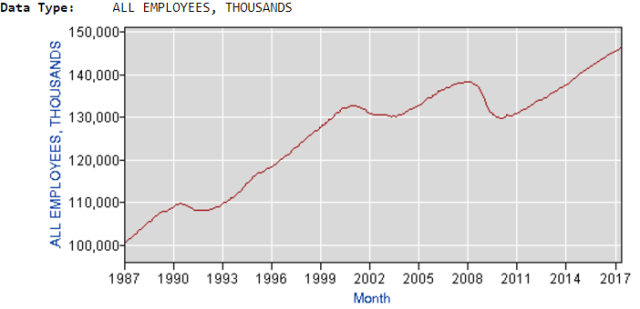
While this topic is a bit much to really get into in this post, I’ll just note that the total number of people employed in the United States is the highest it’s ever been. Unemployment is low, productivity is growing slowly. All of which point to continued employment, at least for the present and near future.

We may yet arrive at this world, but we haven’t yet, and when we do the robots will be better at designing policy than us anyway.

When?

If my chief objection to the UBI is its cost, the obvious question is how much would it need to cost to be worthwhile. I don’t have a perfect answer for this. The most expensive government program, Social Security, is about 5% of GDP. A basic income that cost about this much would provide each person with a couple of thousand dollars a year. Not enough to live on, but a meaningful amount for many people. At this level, we would almost certainly need to maintain most current federal services (although some of them such as SNAP could be converted into cash transfers).

Maybe we could afford it at 10% of GDP. To provide $12,000/year to every adult without spending more than 10% of GDP requires a GDP of $34 trillion, a little less than twice what we have now. At a growth rate in real GDP of 2% per year and a population growth rate of 0.5% per year, we would get there a bit after 2050[8].

12K

A Cheaper Basic Income

There two ways of making basic income cheaper. One is reducing the amount that gets paid out, but if it really is supposed to be an amount that someone can survive on, anything under the amounts mentioned above is probably not going to cut it.

The other way is make it not universal. This would be akin to a minimum income, or negative income tax. This is similar to the basic income in that it establishes a cash floor for recipients, but fundamentally different in that it is means tested and not universal.

Can We Afford a Universal Basic Income?


A universal basic income would require both substantial tax increases and for the basic income to replace current government. While I am sympathetic to the promises of a basic income, I have a hard time justifying the expense.

At least for now.


RELEVANT POSTS FROM PARTYSHEEPHATS:

What are some alternatives to the Universal Basic Income?

When is the Minimum Wage too High?

Can the gains from trade be redistributed?

Is Global Inequality Increasing?


[1] There are a few other names for this such as “citizen’s income” which sounds massively more badass.

[2] But perhaps a misleading one, as most poverty measures do not count government benefits.

[3] There is no exact definition for what constitutes welfare spending, so estimates can range widely, depending on whatever point the author is making.

[4] Seems like this would either be a wash or a detriment for social security recipients.

[5] Including state and local

[6] I refer to poverty in the US. For fighting extreme poverty in lower income countries, the math might work out differently.

[7] Example: Imagine how much better this blog would be if it were written by an algorithm. Do androids dream of electric partysheephats?

[8] This is a super rough estimate. You can fiddle with the assumptions here.


References, Sources, and Further Reading:


Forbes.com of course we can afford a universal basic income do we want one though

Futurism.com universal basic income costs less than you might think

www.dailyjournal.net consider universal basic income with an open mind

Cato: universal basic income disease or cure

Freakonomics

How to reform welfare and taxes to provide every american citizen with a basic income

Futurism.com Here’s why experts think universal basic income will never work

World Economic Forum can universal basic income actually work

Basicincome.org real cost universal basic income

Vox universal-basic-income-review

Usnews.com a-universal-basic-income-wouldnt-reduce-poverty

cbpp.org/universal-basic-income-may-sound-attractive-but-if-it-occurred

How much is a bolivar worth?

dannytweetCurrency markets are odd places. They are one of the few financial markets that are zero-sum. Politically, they can be odd as well, the good being exchanged is partially controlled by the government, some countries might want to keep the value of their currency high, others might want to keep it low.

These peculiarities aside, currency markets are fundamentally much like any other market. There are buyers, sellers, traders, and speculators. Like any market there is a single price which brings buyers and sellers together.

But not in Venezuela.

1200px-Caracas,_Venezuela_from_Valle_Arriba_1

Caracas, Looking lovely.

The price of a currency is called the exchange rate. Most prices are expressed in terms of currency, for example the price of a cup of coffee is $2.00 per coffee or €2.00 per coffee or £2.00[1]. Currency is no different, a US Dollar expressed in euros would cost €0.87, expressed in pounds it might be £0.77.

I got those rates by going to the exchange rate tracking website, xe.com which offers exchange rates for any currency you care to name[2]. I can find out that an Azerbaijani New Manat is equal to 37.9 Indian rupees.  Which is information that is unlikely to come in handy in my immediate future.

AZNtoINR

I can also see how much the Venezuelan bolivar is worth. According to xe.com one dollar is worth about 10 bolivars.

USDtoVEF

There is a catch. The catch comes, like so many do, in the form of some red text. Following the link that the red text masks brings me here:

VEFnote.png

Here, there is more red text. This red text is obviously serious, because it is preceded by the word “Notice”. There are three odd things about this, the first is that the official name of the currency is The “Bolivar Fuerte[3]” which means “Strong Bolivar”. Currencies are valuable because people believe them to be valuable, but it’s kind of unseemly to point that out in the title.

The next odd part is the “two”. If an exchange rate is like a price, this would be like having two prices for the exact same thing. This just isn’t done[4] if there were two prices for the same thing all the buyers would want to buy at the cheap prices and all the sellers would want to sell at the expensive price, it just wouldn’t work.

The last odd thing is the word “official”

“Official”

Roughly speaking, there are three ways to determine the value of a currency: floating, fixed, or somewhere in between. A floating exchange rate means that the government does not set an official rate of exchange, instead it allows market forces to determine what the rate should be. Most major currencies including the US dollar and the Euro have their exchange rate determined this way.

The second way is to have a fixed exchange rate[5], in this case the government picks another currency, often a major one such as the US dollar or the Euro, and declares a value relative to that.

The third way is to have a floating exchange rate, but to put a lot of effort into buying and selling the  currency, to adjust the price. This is called a pegged float. When people complain about China manipulating its currency, this is what they are talking about.

Multiple Exchange Rates

Once a country has a fixed exchange rate, it is possible, though uncommon, to have multiple exchange rates for different sorts of goods. This might be done for a special type of commodity that is particularly important to the nation. For example, if a government wants food to be cheap, they could set the price for the foreign currency, used to import foreign food, to be cheaper than it otherwise might be.

Multiple exchange rates, is a way to subsidize imports, but an awkward one.  It has all the drawbacks of traditional subsidies (subsidizing the wrong thing destroys value). In addition, it requires additional bureaucratic process and enforcement, multiple exchange rates provide an easy avenue for corruption and arbitrage.

Venezuela has at least two official exchange rates. There is the rate at 1 USD = 10 bolivar, reserved for food and other essentials, but not available for most people or organizations. Then there is a new rate at around 1 USD = 2000 bolivars[6]. The scarcity of foreign currency makes getting currency at either of these rates very difficult.

Defend the Peg

The tricky thing about having a fixed exchange rate is maintaining it. When a government sets an exchange rate it is obligating people to purchase and sell their currency at the price they set.

This system works fine, if the number of bolivars being bought, is about the same as the number of bolivars being sold. If more people want to exchange their bolivars for dollars, than want to exchange dollars for bolivars, the country risks running out of dollars.

There are a few things that can be done to prevent this.

The government can step in and buy their currency, or the currency they have pegged their currency to, to adjust the difference. This is fine, if the country has the resources to defend the peg. These resources typically come in the form of foreign reserves, which is the stock of foreign currencies that a nation keeps around.

Otherwise it could adjust the fixed rate, to make it more closely match up with what buyers and sellers think the currency is worth.

Lastly, a government can restrict access to the currency or simply make it illegal to sell a currency at any other price.

Or all the above.

Past

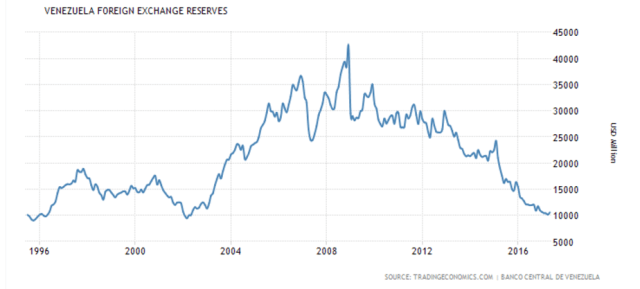
It wasn’t always like this. In the early 2000s Venezuela had the fastest growing economy in the Americas, fueled by high oil prices, it had a larger foreign reserve than Canada, and was expanding social welfare programs.

ForignReserves

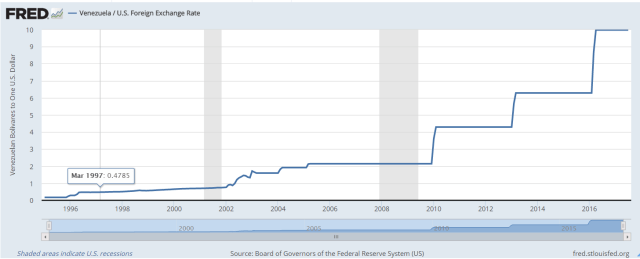
During a strike in 2003, Hugo Chavez introduced currency controls, in an effort to prop up the currency and increase foreign reserves. At this point a dollar could be bought for 1600[7] bolivars, and sold for a bit less.

USDVEFgraph

The Venezuelan economy was (and still is) based almost entirely on oil exports. Oil makes up about 95% of Venezuelan exports, and about half of GDP.  During the boom, it was easier to import goods than to produce them at home, and Venezuela imported a lot. Even during the good times Venezuela imported half its food.

Thanks to the currency controls, to get the currency needed to purchase foreign goods, importers needed to go through the government. This was annoying, but not impossible, since oil is sold in dollars, the country had lots of dollars to spend.

Then two things happened: the oil price went down, and, with impeccable timing, Chavez died.

The fall in oil exports meant there was a lot less foreign currency available but Venezuela still needed to import most things, and to import these things people needed foreign currency.  When there is less of something, it usually gets more expensive. Yet under the official exchange rate(s) dollars remained very cheap.

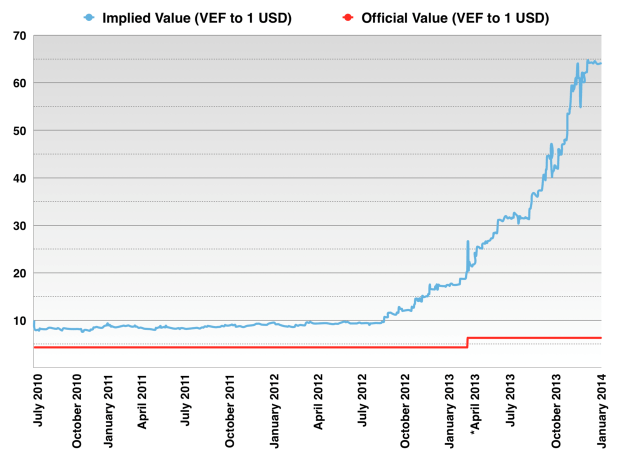
This cheapness, meant that more people wanted to sell their bolivars for dollars, than wanted to sell dollars for bolivars. This made it difficult for everyone who needed it to get forign currency. Because it was difficult to get foreign currency through the official channels, a black-market emerged. The black market did not need to follow the governments set exchange rates. Nor did it. The black market rate and the official rate, began to diverge.

officalvsblackmarket

By ZiaLater – Own work, CC BY-SA 4.0, https://commons.wikimedia.org/w/index.php?curid=38659253

Present

It is illegal to publish the black-market (aka parallel) exchange rate inside Venezuela. Thanks to a Venezuelan anti-government activist working at an Alabama Home Depot it is possible to get data on the black market rate.  The website dolartoday.com publishes a rate, based on reported exchanges in the Colombian city of Cucuta, just across the border from Venezuela. At the time of writing, that rate was a US dollar was equal to 8,493 bolivars.

While uncertain, that is the best measure of the actual value of the bolivar.  It shows that the currency has lost nearly all its value over the last few years. Even though the government no longer publishes inflation figures, Venezuela has officially achieved hyperinflation, with the u­­sual absurdities.

There is a certain tragicomedy in watching currency collapses from afar, but there is nothing amusing about the economic disaster underway in Venezuela. Food shortages, Medicine shortages, skyrocketing crime, unrest, helicopter attacks, are just some of the outcomes from the catastrophic policies that Chavez and Maduro have undertaken.

Danny, don’t buy bolivars.


Thanks to @DJK_Proclaims for this question.

Have a question that doesn’t require an informed answer?

Tweet or email it!


Relevant PARTYSHEEPHATS Posts

Should we get rid of the $100 Bill?

Is global inequality increasing?

Are low gas prices hurting the economy? 


[1] Something, something, purchasing power parity, law of one price…

[2] I like it because it’s easy to remember the URL.

[3] Unless otherwise noted, when I say “bolivar” I am referring to Bolivar Fuerte.

[4] Price discrimination notwithstanding.

[5] Sometimes also called a pegged exchange rate.

[6] This had since dropped to 2,600

[7] When the Bolivar Fuertes was introduced in 2008 one Bolivar Fuertes equaled 1000 bolivars. So this would be 1 USD = 1.6 current bolivars.


Sources, References, and Further Reading

https://www.venezuelaecon.com/

https://www.pri.org/stories/2016-12-01/venezuelas-currency-value-depends-largely-one-guy-alabama-home-depot

https://qz.com/715230/these-are-the-brutal-emergency-measures-it-would-take-to-pull-venezuela-back-from-total-collapse-right-now/

http://www.npr.org/templates/transcript/transcript.php?storyId=498867764

http://www.aljazeera.com/programmes/countingthecost/2016/05/venezuela-looming-collapse-160528081007472.html

http://www.valuewalk.com/2016/01/venezuela-exchange-rates/

https://mises.org/library/venezuelas-bizarre-system-exchange-rates

http://www.nationalreview.com/article/435522/socialism-venezuela-hugo-chavez-nicolas-maduro-bernie-sanders-millennials

http://www.nytimes.com/2003/02/06/business/worldbusiness/venezuela-imposes-currency-controls-to-shore-up.html?mcubz=2

https://www.nytimes.com/interactive/2016/12/30/world/americas/venezuela-hyperinflation-100-bolivar-maduro.html?mcubz=2

http://www.investopedia.com/articles/forex/022415/impact-venezuelas-bolivar-exchange-rates.asp

https://venezuelanalysis.com/news/11206

http://foreignpolicy.com/2017/05/02/the-maduro-regime-is-heading-for-a-soviet-style-collapse-venezuela/

When is the minimum wage too high?

The city of Seattle has recently become the epicenter of the minimum wage debate. In January 2016, the city raised its minimum wage to $13 per hour, as part of a policy that has increased it to $15 per hour. Proponents of the policy claimed, as minimum wage advocates always do, that it would raise wages for low wage workers, while opponents of the policy claimed, like minimum wage opponents always do, that it would cost jobs.

Space_Needle002

Seattle, looking lovely

Last month, researchers at the University of Washington published a paper evaluating the increase in Seattle’s minimum wage. The paper suggested that the increase of the minimum wage to $13 per hour had harmed low wage workers. Minimum wage advocates sharpened their hatchets and went about trying to hack the paper to bits, while minimum wage opponents waved it about gleefully.

They can’t both be right.

Price Floors

Anyone who has ever walked into a store with the intention of buying something, seen the price, and walked out of the store without buying it, is familiar with the idea that when things get more expensive people buy less of them. Those deciding to hire people are no different, all else equal, an increase in wages should result in fewer people hired.

One doesn’t have to venture very far into minimum wage comment threads[1] before someone starts talking about the econ 101 price floor model. Which goes something like this:

A Graph with no Numbers

Pretend that people are buying and selling corn[2] at a price of $2 per corn. Then the government comes along and decides that since corn farmers deserve more money, all corn can only be sold for $3 each. Some people buying corn are not bothered by this, they like corn enough that even at the increased price they are happy to keep buying it. Other people decide that $3 is too much for corn and they decide not to buy it. Corn farmers love this policy, and they decide that since their corn is now going for more, they will try to harvest even more of it. Farmers turn more of their fields to growing corn, Uber drivers taking up corn farming as their side hustle. The result of this is that as less corn is bought, more corn is available for sale. This gap results in a surplus of corn, which just sits around, unbought and lonely. Aside from the farmers who manage to sell their higher priced corn this is annoying for nearly everyone. Corn buyers are mad because they must pay more for their corn. The government is mad because the country is now clogged with unused corn. Corn storage facilities are stoked.

Floor

Perhaps the same model can be applied to labor. Pretend there are a bunch of people willing to work for $10 an hour at fast food restaurants, and that fast food restaurants are happy to hire these people at $10 an hour. Then the government, feeling that $10 an hour is not enough money for people to live on, comes in and sets a minimum wage at $15 an hour. At $15 an hour many people are willing to work in fast food restaurants. However, the restaurants are not so keen to hire people for $15 an hour, so they decide to hire fewer of them: they might cut back on hours worked, decide not to hire new people, lay off current employees, they might even try to automate certain jobs.  This gap between the amount of labor supplied, and the amount demanded, is unemployment.

This is fine, but a bit theoretical. Why trust a graph with no numbers, plus some simplistic assumptions, when we have actual real-world examples of real-world minimum wage increases and data on employment.

Empirics

One reason might be that it’s not easy to figure out the impact of the minimum wage on employment. A good counterfactual is hard to find. Seattle’s strong labor market does not mean that the increase in the minimum wage has not had a detrimental impact. Without the minimum wage increase, it might be stronger still.

A simple analysis would be to compare places that have raised the minimum wage with those which have not. This problem with this is that places that raise the minimum wage are likely to be different from places have not in myriad different ways. They are likely to be wealthier, more urban, and have other progressive policies, any of these things may influence employment.

It is also tempting to look at the changes before and after a new minimum wage is introduced, here the complications persist.  For example, the minimum wage might be increased because the economy is particularly strong, which might make it difficult to determine if the observed impact on employment is due to changes in the policy or underlying economic trends.

To really know what impact an increase in the minimum wage had on employment, it would be necessary to have one place that increased its minimum wage and other place that is exactly like the first place in all respects, except for a lower minimum wage. This will never happen, but it might be possible to get close.

Card and Kruger

Enter David Card and Alan Kruger, a couple of economists who wrote what is probably the seminal empirical paper about the minimum wage. Card and Kruger looked at an increase in New Jersey’s minimum wage up to $5.05 an hour. They examined the change in the number of people employed in fast food restaurants[3] in New Jersey compared to eastern Pennsylvania, which had not raised its minimum wage. New Jersey and Pennsylvania share a border and, at least near the border, things are likely to be similar with respect to things like underlying economic conditions.

In addition, to control for differences between the two states, they looked at differences between restaurants in New Jersey that had, before the new law, paid higher than $5.05, since these places were not impacted by the new law, they could serve as a control group.

They found no increase in unemployment.

More studies followed, and Card and Kruger weren’t the only ones finding this. As an oversimplification, empirical studies have shown that the minimum wage does not make unemployment increase.

Magnitude

Plenty of reasons have been advanced for why this might be the case, one of the most compelling is that minimum wage studies in the past have focused on relatively small changes in the minimum wage.  Especially if employers have market power, they may be able to shrug off small increases in the minimum wage. If the minimum wage were increased by a penny, it is unlikely that it would make any noticeable differences to anyone. Alternatively, if the minimum wage were increased by $100/hr few people doubt there would be significant employment impacts. Presumably, there is a point where the minimum wage becomes harmful to low wage workers. The current question is where that point is, and what determines it.

Seattle 

increase

 From here

 Seattle has been increasing its minimum wage in steps for the last few years. The rate varies on employer size and if workers are offered health insurance. When Seattle increased its minimum wage to $11, the researchers watching, found there was little impact on employment, and what employment loss there was had been, was compensated by the increase in wages.

The study on the jump from $11 to $13, has gotten a lot of attention, although it has yet to undergo peer review.  It is unusually interesting, the researchers had access to an exceptionally rich dataset that included not only wages but hours worked for employees across Washington. This is better than other studies that lacked data on individual jobs and had to use proxies for minimum wage employment such as restaurant employment or teenage employment.

Results

The primary finding is a nearly 10% reduction in the number of hours worked at low wage jobs. This was sufficiently extensive to counteract the increased wages that were being paid, resulting in the average low wage worker making $125 less than they otherwise might. There was also a noticeable drop in the number of low wage jobs. There was no clear indication of a decline in employment (among all workers) in the restaurant industry.

The lack of impact in restaurant employment and relatively small impact in overall employment are in line with other studies. What is not in line with other studies, perhaps because they don’t have the data to measure them, was the reduction in hours and the consequential reduction in total earnings.

If the conclusion is to be believed, it implies that the the minimum wage was harmful to low wage workers, and this is likely to manifest as a reduction of hours rather than a reduction in overall employment.

Single State

There is debate about how seriously to take this study.  One of the concerns is the rich dataset that the study authors used. While exceptional in that it provides hourly data, this data is only available for the state of Washington.  Since Seattle is in many ways unique in Washington-it is vastly larger than any other city in the state-this forces the authors to use other areas of the state as a control group[4], a process which may not have worked.

Multiple location

The dataset used only classifies companies by one address, this means that it is impossible to determine where job losses occurred for companies that contain multiple establishments.  Since there was no way of distinguishing between job losses in Seattle vs. other regions, the authors felt compelled to exclude companies that had multiple outlets.

This is a problem for the results of the study if one believes that companies with multiple establishments are less likely to reduce employment following a rise in the minimum wage[5].

Still, it’s suspect, many companies that employ minimum wage workers have multiple establishments (fast food restaurants are the obvious example). Even if this nullifies the application of the results for businesses in general, they remain valid for the subset of single location-businesses.

The other study

Near when the Seattle minimum wage study was published, another study came out arguing that the increase in the minimum wage had not impacted employment in the restaurant industry. The two studies were often presented as being at odds with each other (an example), even though there were few explicit contradictions (for example, neither showed a decline in employment in the restaurant industry).

What to do with empirical studies?

I was upset with the reaction to this paper. Minimum wage proponents were so quick to dismiss it offhand, while minimum wage opponents held it up as proof of something that didn’t need any proof. Both of these responses are silly.

Empirical research should inform policy decisions. The alternatives are theory, guessing, or making stuff up[6]. In the real world though, empirical studies only ever answer questions in bits. Data limitations, methodological decisions, and the fundamental complications of an interconnected society, make it impossible for a single study to ever concretely answer a research question.

Relying on empirical studies to inform our policy is going to be messy. For contentious and heavily studied policy issues-like the minimum wage-there will be papers that support either side of an argument. It will be possible for anyone to cherry pick valid, yet imperfect, studies that support their argument, regardless of which side they are on.

This doesn’t mean all studies are automatically equally valid, or equally important. Nor does it mean every study should be taken at face value. It is necessary to debate the flaws and inconsistencies of any political or academic work.

What is dangerous is doing this selectively, slashing to ribbons everything you disagree with while giving favored conclusions studies a clean pass. The reason this piece is so awful is not that it’s critique is unfounded, but it calls for people to ignore a study, without even giving it a chance.

When is the minimum wage too high?

As more minimum wages rise there will be more empirical studies, and hopefully quantity will bring consensus, or at least, a more nuanced understanding. In general, the empirical evidence on the minimum wage has not shown large reductions in employment, this study does not reverse these findings, nor do those findings invalidate this study. When is the minimum wage too high? is an empirical question, but an unanswered one.

Relevent PARTYSHEEPHATS posts

How much Consumer Surplus does Uber generate?

Is Global Inequality Increasing?

Will Vancouver’s anti foreigner tax work?

Sources, References, and Further Reading

Card and Kruger

Berkeley Paper (summary)

Berkeley Paper

National Review

Washington Post

Fortune

Civic Skunk Works

Chris Auld

Forbes

Bloomberg[1]

bloomberg[2]

Bloomberg[3]

fivethirtyeight

[1] Don’t do this.

[2] Agricultural goods have often had a price floor.

[3] Fast food restaurants are often used to study minimum wage, because they employ a lot of minimum wage workers, tend to follow these sorts of laws, and their workers tend not to get tips.

[4] Technically they use methods called Synthetic control and interactive fixed effects. I am not sufficiently familiar with these techniques to judge their efficacy or appropriateness. From my understanding, both techniques weigh different regions in ways that their trends prior to the changes in the minimum wage, would be the same. The assumption is that without the impact of the minimum wage laws, the weighted combination of regions offers an appropriate control.

[5] Hard to tell off hand if this is true, multi-site firms might be more able to absorb higher costs, but they might have an easier time moving workers out of the area with the wage increase.

[6] See “theory”.

Should we Privatize Air Traffic Control?

A long time ago, to start off “infrastructure week”, President Trump unveiled a plan to privatize America’s air traffic control (ATC)[1] system. He called the current system “antiquated” and “horrible” and said that through privatization the new system would be more efficient and safer.

Is he right?

If it ain’t broke..

ATL-Tower

There are no interesting charts for this post. So instead we are going to look at the tallest control towers in america. This is the one in Atlanta, it’s the tallest.

Currently, America’s air traffic control system is managed and run by the Federal Aviation Administration (FAA). The FAA employs nearly 15,000 air traffic controllers along with other staff, who work to ensure that American air traffic is conducted safely and without delays. US airspace is, by far, the world’s largest air traffic control system. It has twice as many towers as the next largest system (Russia) but manages massively more traffic. Due to its combination of size and traffic, American air traffic is the most challenging to manage of any country. Despite this, American airspace is as safe as any.

Technology

Still, there are critics. Managing air traffic requires significant technology, and the technology being used at the FAA is old. Due to constraints on government procurement and uncertainty about budgeting, among other inefficiencies, the FAA has been slow to adopt new technology. The multi-billion dollar NextGen program, which is supposed to modernize ATC technology and change radar based systems to satellite based ones has suffered repeated setbacks and cost increases.  According to a 2016 report the costs and timing for the program remain “uncertain”.

The FAA has also has not always followed the efficiency trends of other ANSPs (Air Navigation Service Providers, the general term for an organization that conducts air traffic control).  Between 1997 and 2004, operating costs per aircraft movement at the FAA increased by 20%, while costs in Australia, Canada, New Zealand, the UK, and France declined between 5%-15%[2].   

Privatization, Corporatization, and Commercialization

No one is suggesting that air traffic control should be managed by a private for-profit company beholden only to market forces.  Instead what President Trump is going after is splitting off the traffic management duties performed by the FAA into a separate nonprofit private corporation. This is not a new idea. In this US, there have been various proposals for privatizing air traffic control over the last few decades.  Internationally, quite a few nations have adopted various alternative organizational forms for their ANSPs, these include: complete government operation (US, France), separate government owned companies (Australia, Germany) , public private partnerships (UK),  or private companies (Canada). These alternative structures allow the organization to make business decisions and raise revenue and financing without going through government processes.

Canada’s NAV CANADA system is probably the most similar to the proposed system. Established in 1996, the private, non-profit, corporation manages without any direct government funding. Instead, funding comes from user fees, which depend on the type and size of aircraft and the distance traveled. NAVCANADA is managed by a board of directors that include representatives from the airlines, general aviation, the government, and unions.

IND_tower

The tower in Indianapolis is tall, just not as tall as Atlanta’s

Paying

As with restaurant bills, a lot of the fight about ATC is about who pays.  Currently the FAA is largely funded by the Airport and Airway Trust fund, which gets most of its funding from taxes on domestic passengers, international arrivals and departures, and jet fuel. Other funding comes from general government revenue.

In the proposed plan, revenue would come from user fees. Operators of aircraft, with exceptions for general aviation, would be charged for using air traffic control services. For Nav Canada the fees are based on aircraft type, size, distance flown in Canadian airspace, and other factors.

For most things , it’s best if those who use a service pay for it. Sometimes this is simply too difficult to do (national defense) or overly regressive (basic education).  For air traffic control, neither of these are true. It is certainly possible to fund with user fees, other countries do it. The users of Air traffic control are a relatively affluent segment of the population (air passengers, private pilots)  and the airline industry itself . Having them pay for the services they use seems like the right system.

A potential issue about funding is consistency. One advantage of government funding is that it is relatively unaffected by cyclical fluctuations or shocks (for example the decline in air traffic after 9/11). However, since the current system requires congressional approval is at the, perhaps greater, risk of political fluctuations such as government shutdowns and budget cuts.

Orlandotower

The control tower at the Orlando Airport. Even if we privatize air traffic control, it will still be shorter than the tower at Indianapolis.

Power

America’s major airlines (minus Delta), the air traffic controllers’ union, and Airlines for America the airline industry trade group all support the plan. They would, the board of the new organization would largely be run by the airlines themselves.

This focus on commercial airlines has regional airports and General Aviation groups worried.  They fear that giving the power to an airline centered board, will allow them to prioritize commercial traffic and larger airports.

This seems likely, and if I were an advocate for general aviation, I would probably be opposed as well. Since general aviation is largely made up of recreational pilots, and business jets, this is not a group I would prioritize when designing policy.

Empirics

Other countries have transferred the running of their air traffic control systems, either to private companies, public-private partnerships, or government owned companies. While the empirical data isn’t that robust (there just aren’t that many examples to draw from) corporatization comes off looking good, or at least fine.

According to a 2005 government accountability office report that looked at the commercialization of air traffic control services in the UK, New Zealand, Germany, Australia, and Canada, all had improvements in safety, operating costs, and use and adoption of new technologies following their transition away from a government model.

The most critical of these is safety. US airspace is extremely safe, there has not been a fatal accident of a US commercial passenger aircraft[3]  on american soil since the crash of Colgan Air Flight 3407 in 2009. For an ANSP, there are better measures of safety, such as the number of aircraft proximity incidents. For Germany, New Zealand, Canada, and the UK, proximity incidents declined following commercialization. Air traffic control systems for those nations also experienced reduced operating costs, ease in implementing new technology, and increases in efficiency. A 2009 study also found that safety had largely improved following commercialization.

All that is lovely, but the empirical data presented in these studies isn’t that robust.  Due to technological and process advances, I would expect air traffic control to be constantly improving, regardless of their operational structure. Perhaps if these ANSPs had remained in government hands they would have produced similar improvements.

Of course, just because a change worked somewhere else is no guarantee that it would work here. Due to the huge amount of traffic and unusual prevalence of general aviation, United States airspace is, potentially, unique.

Not robust does not mean untrue. There is little evidence to show a consistent decline in safety, efficacy, or efficiency flowing a change of structure. Even if the counterfactual is weak, there is more evidence of improvement than there is of decline.

My Thoughts

If I were forced at gunpoint to decide between supporting the proposed plan, or keeping the current system I would probably go with the proposal. Gun wielding questioners aside, I don’t have the expertise in air traffic control, or the FAA, to properly evaluate the specifics of the proposed plan. I do not know if it US would be best served by the proposed model, or by a government owned company, or by simply reforming the existing system.

I am in favor of separating traffic management from the FAA. The current structure of air traffic control makes it harder to implement technological changes and improvements. User fees seem a better system to fund air traffic control than taxes-even those on aviation fuel. Efforts will need to be made to make sure there are sufficient reserves in the case of an industry downturn, and that these fees do not unfairly target certain users.  Ultimately, the evidence from other countries who have separated their air traffic control systems, seems more positive than negative.

I do think the proposed system gives too much power to the airlines. I don’t trust the American airline industry and suspect that they already have too much power. I am less sympathetic toward the concerns of general aviation, a group I am not particularly interested in subsidizing.

At the time of this writing, The current plan does not seem to be moving forward in the senate, a fact which I am mostly ambivalent about. Still, it does seem like Air Traffic Control system in the US could be improved, and removing it from under the FAA’s wing[4] is probably a good place to start.


Relevant PARTYSHEEPHATS posts

Why is flying in Canada so expensive?

Should airlines be allowed to overbook?

Why are airfares so volatile? 


References, Sources, and Further Reading


News:

Washington Post

The Atlantic: Why Trump Wants to Privatize Air Traffic Control

The Atlantic : Is Trump’s Plan to Privatize Air Traffic Control a Good Idea?

Forbes

The Hill: The case against privatizing the nation’s air traffic control system

FoxBusiness: business-leaders bash trumps air traffic control proposal

Bloomberg: Trump to Seek Spinoff of U.S. Air Traffic Control From FAA

Slate

Wired

The Hill: Senate panel to reject Trump’s air traffic control plan in aviation bill

Airline and Aviation:

View from the wing

AIN

CANSO: Global ANSP Performance Report2016

AOPA: aopa ga groups oppose atc privatization

Delta: The Costs of Privatizing Air Traffic Control

Government:

CRS: Air Traffic Inc.: Considerations Regarding the

Whitehouse: president trump announcement air traffic control initiative

GAO: Experts’ and Stakeholders’ views on Key Issues to Consider in a Potential Restructuring

GAO: Characteristics and Performance of Selected International Air Navigation Service Providers and Lessons Learned from Their Commercialization

OIT: NextGen

Other:

Commercializing air traffic control: Have the reforms worked?


[1] Unfortunately, this post contains acronyms (UTPCA).

[2] Page 21

[3] More recent commercial fatalities on US soil since then include OZ214 which crashed while landing at SFO, and UPS 1354 a cargo flight which crashed while on approach to BHM.

[4] Pun absolutely intended.

Why aren’t Americans moving anymore?

The Migration Mystery

There is a perception of Americans as an unusually mobile people. We are not content to live and die in the same place as our parents, instead we tirelessly chase opportunities, moving wherever fortune looks favorable and the future looks bright.

But not so much anymore. Americans are less mobile than they have been since the census started keeping track of movement in 1948. Back then, 20 percent of Americans had moved in the previous year, in 2016 only 11 percent had.

A fall in migration could point to a decline of dynamism in the American economy, a benign demographic change, or a positive sign that Americans don’t need to move in order to find the life they wanted.

It all depends on why we’ve stopped moving, and that turns out to be a surprisingly tricky question.  What follows are some theories: all plausible, some backed by data, but with no obvious answer.

But first, the decline.

The Decline

The census keeps track of the percentage of Americans who have moved in the last year. The most recent figure is that 11.2% of the population had moved within the last year. Most of these moves, 6.9% were shorter moves that did not involve leaving the county. About 1.5% percent of Americans had moved to a different state in the last year. Both figures are about half of what they were in the 1980s.


1

Data from here. * indicates a year with multiple values, depending on controls. (In which case, I used most recent set of controls.) See census notes for more details.


The decline is relatively consistent over the years. Which means is not due to some cyclical reason such as business cycles, or even a large one off shock, such as the great recession[1]. Something more fundamental has changed.

Near and Far

People move for all sorts of reasons: work opportunities, family or relationships, school, a simple change of scene, fleeing enemies, or nearly infinite others. Short distance moves are not motivated by the same reasons as longer moves. They tend to be mostly driven by housing related reasons, while long distance moves tend to be driven by employment related reasons.

While short distance moves are vastly more common, long distance moves are probably a better indicator for overall economic and social dynamism. Also, moving across the country is just more interesting than moving across town. So, if you don’t mind, we’ll focus on that.

Age

There are several demographic changes that have occurred in the last 30 years that could help explain the decline in moves. A big one is age. The US population has been getting older. The share of the population that is between 20-34 has fallen since the 1980s, this segment of the population tends to move more frequently than other segments.

3.PNG

Data for all these charts is from here (table 2). Charts are my own.

As an explanation, the general aging of the population would be more credible if there was less of a decline within each age group. Younger people seem to be moving less frequently than their counterparts of a few decades before, but so are older people.

Homeownership

Homeowners typically move one fourth as frequently than those who rent[2]. Partially because selling a home makes moving more difficult, and partially because the sort of people who decide to buy a home are likely more invested in their community than those who rent.

4

Between the 1990s to the mid 2000s, the homeownership rate rose, although it has since declined back to a lower level. The overall trend does not bear much resemblance to the trend in migration, so it seems unlikely that home ownership played a substantial cause in the decline of migration.

5

Education?

Other demographic trends don’t help much either. For example, the changes are not well explained by changes in education levels. As Americans become more educated, they have moved less, even though people with more education tend to move more frequently than those with less education. As with age, the decline in moves has occurred across education levels.

6

According to several economists[3], homeownership and an aging population are associated with about half of the decline in within county moves, but very little of the decline of between state moves.

7

From here (figure 2). See paper for full explanation.

The black line shows the change in migration rate. The dashed line controls for changes in age and homeownership-what the change in migration would be if age and homeownership had not changed over the years. If this line matched the red horizontal line at zero it would indicate that all the change was due to homeownership and age. The increasingly dashed line involves a similar approach for more variables (listed in the note). Homeownership and age do not make a big impact on interstate migration.  Other variables matter more, but had they not changed it would have resulted in more migration, not less. 

Land Use

In the most prosperous American cities the increase in housing has not kept up with the increase in housing demand. San Francisco is probably the most obvious example. Since the mid 90s, the amount of housing in San Francisco increased by only 12% while the price has increased by 341%. More people might move to San Francisco, but restrictions on housing stock could be stopping them.

Still, I’m sort of skeptical about this being a sizeable contributor. The change in migration is over a long enough time period, and for a large enough area that I don’t think changes in specific real estate markets are consistent enough to explain it. If the change was due to changes in house prices, it would have been more influenced by the housing bubble and subsequent housing crash. It wasn’t.

Changing Jobs

Since the early 90s Americans have changed jobs less frequently. Especially for long distance moves, there is a logical link between job switching and moving, as most people who make a long-distance move change jobs.

This link could go either way, a decrease in job switching could be both a cause of lower mobility or a consequence of it. It looks like the relationship is not being driven by the process of people moving. Job switching is lower in states that fewer people are moving to, even for those who have not moved.

Licensing

There has been an increase in the number of occupations that require state based licenses. Twenty two percent of workers have a government license of some sort. The percentage of workers who require state based licenses have increased 28% since 1980.  Since these licenses usually do not transfer between states, the cost of moving is higher for people whose profession require a license.

Indeed, workers with a state license are about as likely to move within a state as non-licensed workers, but are much less likely to move in between states.

While licensing almost certainly limits mobility for those in licensed occupations. It’s not clear if the effect is large enough to explain much of the decline in migration.

Why are workers changing jobs less frequently?

If workers have stopped moving due to less frequent job changes, the question then morphs to why aren’t they switching jobs as much. There are several potential reasons for this, all possible, none obviously dominant. It would be especially nice[4] if this reason could also explain changes in movement.

Changes in type of occupation

Over the past few decades, the US labor market has bifurcated away from middle skilled work (think things like administrative, manufacturing, and sales jobs) into low skill and high skill occupations. If a large source of past geographic movement was due to movement from low skill to middle skill occupations, this new gap could contribute to the decline in interstate migration.

This doesn’t seem to be the case. While mid skill work is associated with increased movement, the changes in the proportion of middle skill employment are not large enough to be a sizeable contributor to changing patterns in movement. Movement rates have declined evenly across education levels, which means that the decline is likely not due to changes impacting any particular demographic.

Information on Place

It is possible that the decline in moves corresponds with the rise in the ease of obtaining information about potential places to move to. Information could be more easily obtained thanks to declining travel costs and the increase in information technology. Perhaps people don’t need to move to find or investigate opportunities, but can conduct their research from afar and only move when the opportunity seems particularly enticing.

The ease of obtaining information is not an easy thing to measure. One way to obtain information about how much you like living in a place is to try living there, if you like it you stay, and if you don’t[5] you can leave.  Greg Kaplan and Sam Schulhofer-Whol  present evidence[3] that this sort of experimental migration has declined since the 1970s. They are also able to incorporate this sort of information into a model of migration.

All of which is fine, but it doesn’t say much about why people might switch jobs less. As most long term movement is undertaken for job related reasons, I am skeptical of this sort of movement being a significant driver.

The same opportunities, everywhere.

If certain kinds jobs are only available in certain locations, it is necessary for most people to move to get those jobs. The more jobs are specific to certain locations the more people will need to move. For the last few decades that the number of different occupations available in a locale has tended to increase.

Local labor markets have become more diverse in terms of the kinds of jobs and opportunities they offer, which means that it is not necessary to move to pursue a particular career. The degree of occupational segregation between states has declined substantially over the past couple of decades.

thiel

From here


While this fact might explain a decline in movement, it needn’t explain a decline in job switching. More types of local opportunities might easily lead to more job switching, not less.

The same wages, everywhere.

A similar impact is that the wages within occupations vary less between cities than they used to.  If a worker can make more in one location than another, while still doing the same job, they will be more likely to move. Just as American cities are becoming more diverse in terms of which occupations they contain, the difference between wages between locations, within a given occupation, has generally fallen.

Changing employers

There is evidence that the benefits (measured in an increase in wages) to changing employers has declined while the benefit of staying with an employer has remained constant. Fewer benefits from job switching would lead to workers changing jobs less, and consequently migrating less.

This would provide a nice reason for both a decline in job switching and a decline in movement. Unfortunately, it raises additional questions. It’s not clear exactly why this would be occurring-some possible reasons might include a general decline in worker bargaining power or a decline in unionization.

Should we worry?

While I haven’t found a certain reason that is responsible for the decline in movement, I would veer toward pessimism.  There are a number of ways in which the American labor market has become less dynamic, not only less job switching, but also fewer new firms being created, and fewer people being hired or leaving their jobs. Whatever the exact cause, the decline in migration is probably not good news.


(Not terribly) Related PARTYSHEEPHATS posts

Why is Flying in Canada so Expensive?

Who are the Self Employed?

Which Unemployment Rate is Best?


Footnotes

[1] The technical term for something that steadily changes over the long term and not cyclical is “secular”.  I just learned this.

[2] https://www.federalreserve.gov/pubs/feds/2013/201327/201327pap.pdf -Table1

[3] Raven Molloy, Christopher L. Smith, and Abigail Wozniak

[4] as Molly, Smith and Wozniak point out

[5] If, for example, you have unwittingly moved to Reno.

Sources, References, and Further reading

Papers

https://www.federalreserve.gov /pubs/feds/2013/201327/201327pap.pdf

https://mobile.minneapolisfed.org/research/wp/wp697.pdf

http://pubs.aeaweb.org/doi/pdfplus/10.1257/jep.25.3.173

https://papers.ssrn.com/sol3/papers.cfm?abstract_id=2896309

https://www.federalreserve.gov/pubs/feds/2013/201327/201327pap.pdf

https://www.brookings.edu/wp-content/uploads/2016/03/MolloyEtAl_DecliningFluidityLaborMarket_ConferenceDraft.pdf

News

https://www.washingtonpost.com/news/wonk/wp/2013/05/15/the-united-states-is-still-one-of-the-most-mobile-countries-in-the-world/

https://www.washingtonpost.com/news/wonk/wp/2013/05/11/why-arent-americans-moving-anymore-heres-a-new-theory/?utm_term=.53271ade93a0

https://www.aol.com/article/finance/2017/01/06/why-arent-americans-moving-anymore/21649372/

Other

https://www.census.gov/newsroom/blogs/random-samplings/2017/01/mover-rate.html?cid=17mover-rate

http://www.pewresearch.org/fact-tank/2017/02/13/americans-are-moving-at-historically-low-rates-in-part-because-millennials-are-staying-put/

https://www.census.gov/newsroom/blogs/random-samplings/2017/01/mover-rate.html?cid=17mover-rate

https://www.census.gov/data/tables/time-series/demo/geographic-mobility/historic.html


https://reason.com/archives/2017/01/13/why-arent-more-americans-movin1

https://fivethirtyeight.com/datalab/enough-already-about-the-job-hopping-millennials/


https://www.citylab.com/equity/2017/02/american-mobility-has-declined/514310/

http://blog.credit.com/2017/01/heres-why-no-one-is-moving-out-west-anymore-164367/

https://www.theatlantic.com/business/archive/2012/11/why-arent-people-moving-in-america-anymore/264549/

https://fred.stlouisfed.org/series/RHORUSQ156N

Should airlines be allowed to overbook?

UA 3411

By now you’ve seen the video. On a United flight from Chicago to Louisville, Dr. David Dao was beaten, bloodied, and literally dragged from the aircraft, after he refused to give up his seat when instructed to do so by crewmembers.

DragandDrop

It’s been an exceptional week for memes. This one unfortunately was too good to be true.

The beating of Dr. Dao was inexcusable, and the incident naturally provoked outrage. Some of that outrage was directed at overbooking, which is when airlines (or other businesses) sell more tickets than they have seats. New Jersey Governor Chris Christie called for an immediate ban on overbooking.

Overbooking

Nearly all airlines overbook flights. The assumption is that there will always be a few no shows, people who do not show up for a flight either due to missed connections, tardiness, or a change of plans. The practice results in more money for them and, presumably, cheaper fares for passengers, due to the increased supply of tickets. As airline customers largely choose which tickets to buy based on cost, this is a significant benefit.


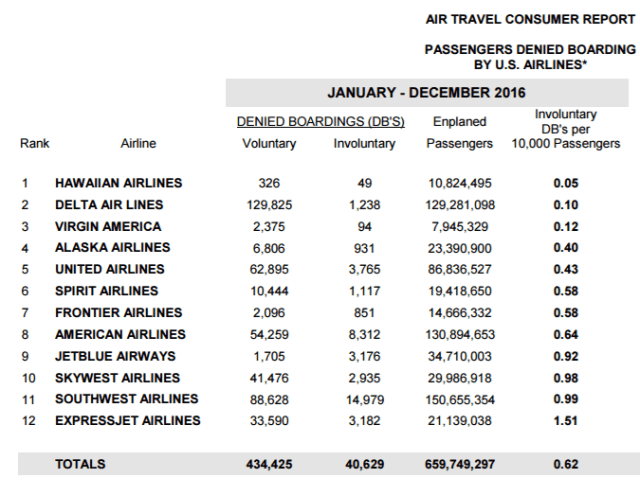
Airlines model out the chance that a flight will be overbooked and try to strike a balance between filling the aircraft and overbooking it. They generally do a good job. Denied boardings make up fewer than 0.1% of all enplanements.  The vast majority of these (92%) are voluntary.

beatcustomers.PNG

VDB & IDB

When a flight is overbooked airlines first ask for volunteers who are willing to take a later flight in exchange for compensation, typically a hotel stay and some amount of credit for future flights on the airline. In these situations, the passenger is often quite happy to take the compensation, this is called a Voluntary Denied Boarding (VDB) and it can be awesome.

The issue is when no one volunteers.

In these cases, the airline is going to have deny boarding. This is perfectly legal, and technically agreed to in the fine print of the ticket purchase. How to do this is up to the airline, last to check in, lowest fare paid, or some form of randomization, are the most common methods.

In an involuntary denied boarding (IDB) the airline must compensate the passenger for their inconvenience.  There are rules for this. The amount depends on how long a passenger is delayed, for a longer delay the compensation is 4x the one way fare, up to a maximum of $1350.

I have seen some commentaries that the case of Dr. Dao should not be considered a IDB as Dr. Dao had already boarded the aircraft, and therefore it isn’t a denied boarding, and it falls under different rules instead. This is a question I’ll leave to the inevitable lawsuits and salivating aviation lawyers.

fightclub.PNG

$1350

Following this weeks “re-accommodation” Of Dr. Dao, there have been calls to raise, or eliminate, the limit airlines are required to pay out in the case of an involuntary denied boarding (IDB). Eliminating it would require airlines to keep upping their bids until a passenger was willing to accept.

Both elimination and raising the cap would put more power in the hands of the passengers when there was an overbooking situation. Both would raise the cost of IDBs to the airline and make them more cautious about overbooking, which would make denied boardings of all sorts less common. It is likely that it would slightly raise the cost of flying for everyone, and airlines would make less money.

In this case, United offered $800 or $1000 (reports seem to differ) in vouchers for volunteers to take a later flight and didn’t get enough takers. They did not up their offer, but instead elected to remove passengers. A higher value would have probably been accepted, there are reports of someone on the aircraft saying that they would leave for $1600.

There are reasons to have a cap on the amount that can be offered. Airlines do not have unlimited time to negotiate with passengers about compensation. Pilots have time restrictions and flights need to leave on time.  For these reasons, it makes sense to have a cap that airlines can fall back on when negotiations break down. In these situations, the airline should be the one to bear the cost, and the IDB cap should reflect this.

EK.PNG

From a real ad

Eliminate Overselling?

It is odd that overbooking has received so much attention, because UA3411, was not oversold. Initially the aircraft was simply full, but United needed to transport four crew members for a flight the next day. The details of this are not clear to me. Perhaps United could have put them on a later flight, or found a different crew. Perhaps United messed up and should have already had a crew in Louisville.

There might be good reasons for the flying public to want United to be able to kick people off a flight to accommodate its crew. One difference between air travel and other ticketed events, such as concerts or sporting events is the way that problems can reverberate and magnify as they propagate through the system[1].  Better to inconvenience four passengers in Chicago than cancel a flight in Louisville and inconvenience a whole plane load. Even if airlines were prohibited from overbooking there would still be instances where passengers are denied boarding, or asked to leave the aircraft, due to equipment swaps, weight issues, or other operational challenges. To eliminate these situations would require levels of redundancy that neither the airlines nor the flying public are willing to pay for.

Compensation

Were I a regulator, I would raise the compensation that airlines are required to pay out to involuntary denied passengers. Based on no data what so ever, 5-10 times the current level sounds about right. IDBs suck, and we want airline inventory analysts to be scared of them. I would advocate against banning overbooking, the overbooking system mostly works as intended, and is beneficial. What happened on UA3411 was a failure, but it was not a failure of how flights are sold.

police.PNG

Not very human

UA 3411 was never about overbooking anyway. I think one reason (among many) that this video got so much attention is that as air passengers we inherently understand that airlines do not like us. We find ourselves trapped in an airport we’ve never heard of, being bossed around by screens. We are told to check in early and then wait around when the flight is late, we get segmented in numbered boarding groups, and then get charged for everything. If things go wrong we have even less control. We wait in line to be told that there are no options, that “everything is booked”, and “the next flight out isn’t until tomorrow.” The whole enterprise just doesn’t feel human at all. Frankly, we wouldn’t put it past United to beat someone up and drag them from the plane, we’ve already kind of suspected they might try such a thing on us.

[1] Just ask Delta


Related Articles: 

Why are airfares so volatile

Ultra-Long Haul Flights

What’s the furthest airport you can get to (without stopping) 

Are fares higher at larger airports

Why is flying in Canada so expensive


Should the United States auction work permits?

Decisions

In the center of the immigration debate there is this fundamental idea that doesn’t get explicitly talked about much. Maybe it’s too central, too obvious, too inherent. As a country that millions of people want to move to-we get to pick who comes here.

The debate is usually couched in terms of being for immigration or against it, but all countries and most people support some limit on the number of immigrants.  As long as there is a cap, there will always be more people who would like to come, but can’t.  In 2015 the US issued about a million green cards. 50,000 of those were under the diversity lottery, a program that gives green cards to migrants from countries which typically don’t send many immigrants to the US. The number of qualified applications for the 50,000 slots, was 9.3 million.

Which means that there must be a way to decide who gets to come in and who doesn’t.

Motivation

This is not easy. People migrate for all sorts of reasons: economic opportunity, family ties, escaping war and oppression. Governments also have all sorts of reasons to encourage immigration: population growth, attracting workers, supporting refugees, encouraging multiculturalism and a diverse society. The ‘who to prioritize’ question is a deep question because it says something about what the society thinks is important.

There are lots of countries that have to make this decision, and they have different ways of doing so. For skilled workers, Canada has a points based system, and those who score highly (younger people, those with more education, strong skills in English or French, and more ties to Canada) are prioritized.

The US basically breaks down its permanent residency visas (green cards) into four categories: those joining family members, those coming to work, refugees, and a fourth category that is designed to attract migrants from countries that typically see low amounts of US migration.

Most of these categories are broken down into subcategories. In most of instances there are caps on the number of people admitted to both the subcategories and the larger categories. There is no cap to the number of immediate relatives (children, spouses, and parents) of US citizens that can enter each year. The second largest category, which includes the extended family of US citizens, plus the family of permanent residents, is capped at 226,000. The cap on employment based green cards is 140,000.

GC2015

Waiting

An applicant might have an easy time or a hard time depending on where they are from and which visa category they qualify for. The variation is partially caused by a cap on migrants from each country. A maximum of 7% of employment and family visas are issued to immigrants from any given country. This cap is not adjusted for either the population, nor the number applicants, of the country. As a result there are long wait times for those coming from countries with a lot of applicants.

For those applying in a category with more applicants than spots there is a waitlist. The waiting time can vary massively, from no wait at all, to years. For Mexican adult children applying to join their citizen parents, the wait time is over 20 years. For Indian workers without a graduate degree it is over ten. Alternatively, anyone who meets the requirements of the most exclusive employment category, priority workers, can come right in.

Citizens of countries that typically see fewer migrants, are eligible for the Diversity Visa program which gives out 50,000 green cards each fiscal year, via a lottery.  It only takes the equivalent of a high school education or two years of work experience to qualify, but a tremendous amount of luck to get a visa. In 2015 nearly 10 million people applied for the 50,000 spots.

Employment Based Immigration

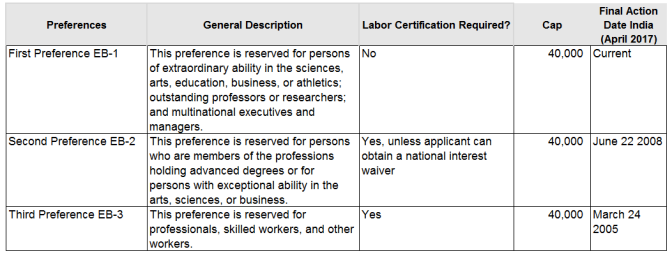
As in most countries, one goal of US immigration policy is to encourage workers to come to the US and engage in work that will benefit both US employers and the US economy in general. In nearly all cases, employment visas require sponsorship from an employer. Among other things, this means that, at least for non-temporary workers, an employer must first prove they cannot hire an American for the role in question (a process called Labor Certification).

EB1-3

The core of this table is here. Final Action Date, is the most recent application date that is available for Visas. India was chosen due to its long wait lists for EB visas.

Applicants for employment based green cards apply in one of five categories (with the first three being the most prevalent and shown above).

The first category, EB-1 includes persons of extraordinary ability[1] such as those who have won Olympic Medals, been awarded Oscars, or are otherwise notable in their field. Unlike most employment visas, these people do not need labor certification. Also eligible for EB-1 are prominent professors and business executives although these people do require labor certification.

The second preference is for those with substantial work experience, advanced degrees or other high qualifications. The third preference is for those with Bachelor’s degrees, skilled, and unskilled workers. Even though the category for skilled workers (EB-3) is much broader than the other two, the same number of visas 40,000, are reserved for each subgroup. This is the primary way the US prioritizes which workers it will allow to become permanent residents.

There is a similar system for temporary workers, in which workers are categorized and a certain number[2] from each category are accepted. There are separate categories for skilled and unskilled workers. These have some quirks, the skilled worker (H-1B) category, also includes fashion models “of distinguished merit and ability”, along with other skilled occupations. Workers with master’s degrees have a better chance at a visa than those that do not. There are separate visa categories for occupations like artists and athletes.

Luck and Haste

Foreign workers face a more awkward hiring process than other workers. After the traditional job search process is done and the company finds a worker who they would like to hire, they submit the paperwork sponsoring the worker to US Customs and Immigration.

If there are more applicants in the visa category than there are available visas, and there probably are, there is additional uncertainty. While there is a waitlist for green card applications, there isn’t one for temporary work permits. Depending on the number of applicants and the type of visa, there may be a lottery or visas may be awarded on a first come, first serve basis.  Contingent on their luck or haste the worker might or might not get in.

This is all rather crude. If the company would like to employ multiple foreign workers, some of them might get in, some might not. The company has no mechanism to express which workers are more important to them, and within the category there are only limited mechanisms (such as visas reserved for workers with master’s degrees) for differentiating between workers.

Highest Bidder

[I first came across this idea from Giovanni Peri, in this planet money show. He has also written about it here and here.]

The right to employ a foreign worker is a resource that has been made scarce by imposed caps and limitations. Most scarce resources are allocated by markets. Market allocation works better for some things (say toasters) than others (say healthcare), but for foreign workers it would almost certainly work better than the current system.

Visas would be auctioned each year to those companies who wished to hire a foreign worker.  At least initially this would involve two separate auctions that would take the place of the current distribution system of H1B (skilled) and H2 (unskilled) temporary work permits.

The proposal allows for companies to submit a sealed bid with the amount they would be willing to pay for the right to hire a foreign worker. If a bid was selected, the worker would get a temporary work permit, which would allow them to work in the US for three years[3], and employers would receive a permit allowing them to hire a foreign worker. The foreign workers would not be obligated to remain with the employer who had paid for their permit, but would be allowed to work for any company that had the appropriate permit to hire foreign works.

It would almost certainly be a more efficient system than the current one.  The chief advantage is providing a mechanism that allows differentiating among potential workers, depending on how much their skills are valued by employers.

There would be other benefits as well. The most obvious one is revenue, this program could bring in around a billion dollars[4] in revenue each year. Auctions would provide information on where foreign workers were most valued, and where the US workforce was lacking. If nearly all the visas went to software developers and economics bloggers, it would be obvious that there was a deficiency in these professions. Since there was a price attached to this discrepancy it would be possible to see the magnitude of this gap, as well as how it changed over time.

Not for everyone

Of all the reasons a country might wish to attract immigrants, hiring foreign workers, especially temporarily, is probably the most selfish and mercantile.  Unlike the immigration of refugees and the family of current residents, which are linked to ideals of helping and togetherness, importing foreign workers is much more like importing anything else we need but don’t have domestically.

To be certain, a lot of the benefit goes to the workers themselves in the form of huge wage increases relative to what they would make elsewhere. The company that employs the worker, also benefits, as they now have a productive worker they couldn’t otherwise have.

While it would undoubtedly be a mistake to conduct all immigration via the highest bidder, for temporary workers (and maybe employment based green cards?) it seems absolutely appropriate.

Let the wealthy in?

It is not obvious exactly what sorts of workers would be prioritized under this system, but they would probably be the most well-paid of the current crop of applicants. Prioritizing the most highly paid forign workers might seem antithetical to the spirit of opportunity that is associated with immigration.  However, merely by having a relatively small cap on the number of legal immigrants and temporary workers, the United States already prioritizes immigrants who already have significant skills and opportunities. We just do it crudely.

If the goal is to provide immigration opportunities to a diverse pool of applicants, the best way to do this is not through the skilled worker program, but to increase the overall number of legal immigrants, modify the country caps, and expand programs like the diversity lottery. If one is concerned about giving away immigration status to the wealthy, a better target is the EB-5 Program which offers permanent residency to those who invest $1,000,000 in a US business.

No line to wait in

No country allows unrestricted immigration. Countries that cap immigration will always be forced to prioritize the admission of some immigrants over others. How to best do this will always be a complicated question, impacting who migrates through both official and unofficial channels.

The US does get to decide who gets to come legally, but it doesn’t always get to decide who comes in. Currently, a Mexican worker with no family in the United States and a high school education, has basically no way to legally migrate to the United States. It is not even a matter of enduring a long waitlist, there just isn’t a category to wait in.

In a time of wall construction and travel bans, it might seem like there are more important immigration topics than a couple year-old, wonky, tweak to a part of the immigration system that impacts a relatively small percentage of immigrants, and there probably are. I find the idea of selling work permits interesting not so much because it will solve all our immigration issues, although I think it would be an improvement, but because it makes me think explicitly about how we go about deciding who to let in and who we don’t. Any serious conversation on immigration should start there.

Sources, References, and Further Reading


US Customs and Immigration Services

https://www.uscis.gov/working-united-states/permanent-workers

https://www.uscis.gov/working-united-states/permanent-workers/approval-and-denial-statistics-i-140-immigrant-petition-alien-workers

Visa Categories, wait lists, and caps

https://www.americanimmigrationcouncil.org/research/employment-based-visa-categories-united-states

https://travel.state.gov/content/dam/visas/Statistics/Immigrant-Statistics/WaitingListItem.pdf

https://www.quora.com/Is-the-waiting-list-for-U-S-Green-Cards-7-years

https://travel.state.gov/content/visas/en/employment/temporary.html

https://travel.state.gov/content/visas/en/law-and-policy/bulletin/2017/visa-bulletin-for-april-2017.html

Employment Certification Form

H1B Occupations

News and Media

https://www.nytimes.com/2017/03/01/us/politics/immigration-trump.html?smid=tw-nytimes&smtyp=cur&_r=0

http://www.economist.com/blogs/democracyinamerica/2011/05/immigration

http://www.npr.org/sections/money/2017/02/08/514152963/episode-436-if-economists-controlled-the-borders

https://www.bloomberg.com/view/articles/2017-03-24/immigrants-are-making-the-u-s-economy-stronger

http://www.pewresearch.org/fact-tank/2015/10/05/todays-newly-arrived-immigrants-are-the-best-educated-ever/

http://news.nationalgeographic.com/news/2013/06/130630-immigration-reform-world-refugees-asylum-canada-japan-australia-sweden-denmark-united-kingdom-undocumented-immigrants/

 Selling Work Permits

http://economics.ucdavis.edu/people/gperi/

http://www.slate.com/articles/business/moneybox/2012/02/auctioning_residency_permits_could_raise_a_lot_of_money_and_solve_the_illegal_immigration_problem_.html

http://www.npr.org/sections/money/2017/02/08/514152963/episode-436-if-economists-controlled-the-borders

Brookings

http://www.scpr.org/blogs/multiamerican/2012/05/17/8262/work-permits-and-auctions-a-look-at-two-new-propos/

Hoover

Statistics and Data

http://www.ncsl.org/research/immigration/us-immigration-snapshot-2011.aspx

https://www.dhs.gov/immigration-statistics/yearbook/2015

http://www.npr.org/templates/story/story.php?storyId=5404217


FOOTNOTES

[1] There are categories for both persons of extraordinary ability which is a subcategory of EB-1 and persons of exceptional ability which is a subcategory of EB-2. Persons of extraordinary ability is the better one to be in. Obviously.

[2] There are some uncapped categories such as temporary agricultural workers.

[3] one year for those receiving the equivalent of H-2 visas.

[4] Or, measured another way, about 1/20 of the cost of the proposed border wall.


Relevant PARTYSHEEPHATS posts

Where should you move if you want to qualify for the Olympics, but aren’t good enough?


Not Relevant PARTYSHEEPHATS posts

Why are airfares so volatile?

Should we get rid of the $100 Bill?


Is Scrabble more Equal than Belgium?

It is surprisingly simple to rank countries by their relative income inequality. Surprising, because income inequality within a country is not straightforward and the economies of different countries can vary drastically.  Simple, due to a hundred-year-old measure of income inequality called the Gini coefficient.

Gini Coefficient

The Gini coefficient is the most common way to measure a country’s inequality. It ranks equality on a scale from 0 (perfect equality, all values being the same) and 1 (perfect inequality, where one person has everything and the rest have nothing.) Income inequality  Gini coefficients for countries vary from about .237 (Slovenia) to .632 (Lesotho). (Sometimes, as in that link, the values range from 0 to 100 instead of 0-1, in this case the indicator is called the Gini Index.)

The Gini coefficient allows the complicated matter of inequality to be turned into a single number.These numbers allow inequality in different countries to be compared to each other and tracked over time.

There is an issue with this, I don’t have an intuitive sense of what these distributions look like. The United States has a Gini of 0.45, but it’s hard to get a grasp of what that might mean. I can tell it’s less equal than Japan and more equal than Brazil, but that’s about it. 0.45 is sort of in the middle of the 0-1 scale, does that mean this is a middle level of inequality.

How does it compare to something else, for example, the board game Scrabble.

Scrabblescrabble-243192_960_720

Those who have had the misfortune to experience the game, will know that Scrabble largely consists of small squares with letters on them. Each piece is worth a certain number of points, common letters such as E are only worth one point, rarer letters, such as Q and Z, are worth 10.  The more common letters are also more prevalent than the high point letters, so there are a bunch of low point letters and a few high point letters. If a country had its income distributed the same way the points were distributed over the pieces in a scrabble set, how equal would it be.

Specifically, would it be more equal than Belgium.

A Diagonal Line

Throughout history, dreamers and visionaries have tried to imagine what a world of perfect equality might look like.  As It turns out, it looks like a diagonal line.

equalline

This is a line of equality which plots the cumulative share of the population vs. the cumulative share of income. In a world in which everyone has the same income, this results in a straight line.

Of course, we do not live in this linear world, we live in one that looks more like this:

Lorenz

This is a Lorenz Curve, showing the inequality between countries in per capita gdp (as a proxy for country wealth).  To create this, each country is put in order from the poorest to the wealthiest, then each country’s share of the total (per person) income is calculated. The cumulative share of income is added along the vertical axis and the cumulative share of countries are added along the horizontal axis.

In the line of perfect equality the poorest 60% of countries will have 60% of the total income. The real world is, being far from perfectly equal, the poorest 60% of countries only combine for about 20% of total per-person income. The closer the Lorenz Curve is to the line of perfect equality the more equal the society is, and the further away the less equal.

This is summarized in the Gini coefficient which is the ratio of: the area between the line of equality and the Lorenz curve, and the total area under the line of equality.

calculating GiniGini Coefficient = The dark gray area/(dark gray area + light gray area)
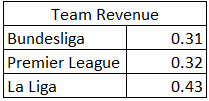
In this case the Gini coefficient is 0.52.

Sports

It is not difficult to calculate a Gini coefficient for things that are not countries. All that is needed is a distribution or a list of non-negative numbers.

One place that is a lot more equal than the world at large is major league sports. Sports and Numbers, calculated Gini Coefficients by revenue for Major Sports Leagues, as well as player income.

Team revenue in the major North American leagues is very equal:

teamrev

This is much less true of the major European Soccer leagues:

temrev-euro

While team revenues are equal, player salaries very much are not.

players

(For reasons as to these differences, along with the associated Lorenz Curves, I encourage you to check out the Original Blog Post at Sports and Numbers.)

MLB salaries are more unequal than nearly any other country in the world. Of course, every MLB player, even the ones who doom my fantasy team, makes hundreds of thousands of dollars a year, so it’s hard to feel too sorry for them.

Crime

An example of a non-income related inequality is Crime. Some places have high levels of crime, others do not.

Using the numbers from the Wikipedia page on crime rates by US cities, I calculated the following GINI indexes. These reflect how equally various sorts of crimes are distributed among US cities.

crime

There is significant variation in crime rates, but this variation differs among different crimes. Murder is, perhaps not surprisingly, the most unequal. Arson is high, driven by very high values in Detroit and Cincinnati. Less serious crimes, such as theft and burglary tend to be more equally distributed, and property crime is more equally prevalent than violent crime is.

Other Things

Since I was already on Wikipedia, I did what anyone on Wikipedia does, I kept clicking on things. Before long I had found data on all sorts of different things.

These things run from the nearly equal (the number of days per month), to the wildly unequal (there are hundreds of airports with just a few thousand passengers, and a handful with many millions.)

things

While the views among the top YouTube Videos are fairly equal, if all YouTube Videos were included the inequality would likely be extremely high, as there are probably millions of videos with essentially no views. The same is almost certainly true about US towns and cities, if all towns and cities were included the inequality would likely be very high.

The Days spent in Office by US presidents gini is probably particularly high right now, as President Trump has only spent a few ( 54 when I pulled the data) days in office so far. That leaves two presidents, Trump and William Henry Harrison, who have served less than 100 days in office, with most of them serving over a thousand.  Since there aren’t that many presidents, these two make up about 4% of the total crop.  That matters in terms of the inequality of days in office, as can be seen from the Lorenz chart below.

daysinoffice


Books and Belgium

This sizes of drinks at Starbucks, the length of books on my bookshelf, how long US presidents tend to be in office, are all things I have a sense of. Income inequality in the US is more unequal than these things. It is also more unequal than the points in a Scrabble set.  Personally, I’ve always thought that the distribution of letters in a Scrabble game was shockingly poorly distributed, as it consists entirely of letters that I didn’t want.

The question of inequality is, essentially, a question of what we want society to look like.


20170323_123537

Ireland

I am fortunate to have a bookshelf filled with quality books, largely worth re-reading. While there are fatter books and thinner books, nothing seems grossly out of proportion, even including the occasional stray textbook. I would be happy to live in a society where income was distributed like the pages in those books. The Gini coefficient of pages in the books on my shelf is 0.315. This is more equal than most countries, although Ireland is close with a Gini of 0.313.

Belgium, which is one of the most equal countries on earth, is more equal still at 0.259.

That makes it much more equal than a Scrabble set.

And isn’t that a good thing to know.


Related Articles:

Is Global Inequality Increasing?

How should inequality be measured?


Sources and Further Reading: 

Sports and Numbers

Country Gini coefficients

State Gini coefficients

How to Calculate Gini coefficients with R

Full data and data sources are here.


Gini coefficients were calculated in R using the ineq package.


Is Global Inequality Increasing?

This seemed like it should be such a simple question.

I like this question for two reasons. First, It could be a simple way to gain insight to complex issues of globalization and trade, poverty and fairness. Second, and perhaps more importantly, it seems like an answerable question. Inequality is, basically, empirical and measurable.  Sure, global anything is complicated, so these measurements might be uncertain, but the general direction should be well agreed upon.

This is pretty much what I thought before I started writing this post.

Then I googled “Is global inequality increasing?”


GoogleInequaliyt.png

What this does not look like, is a consensus. Based on the headlines, three articles seem to indicate global inequality is rising and three say it is falling.

An Answerable Question

Is that even possible? How could different people come to different conclusions about something that seems so empirical. It’d be like people disagreeing about the reality of climate change.

Global inequality is a big, faceted, topic.  This complexity means showing global inequality as increasing or decreasing, may be as simple as just picking a particular way of looking at it. Writing in The Gaurdian, Jason Hickel mentions that in 2000 the people in the richest country made 133 times the income of those living in the poorest. In 1960 that ratio had been 33 times. Tyler Cowen says that “income inequality for the world as a whole has been falling for most of the last 20 years”, citing a paper by Christoph Lakner and Branko Milanovic.

Despite these differing opinions, I maintain that this is an empirical question, which means it has an answer.

Probably.

Decisions

There are many things that can be unequal: life expectancy, education, quality of housing, and, of course, money. Even if one is content to just look at money, there is the choice to look at inequality in income, inequality in wealth, or inequality in consumption.


What is Inequality, exactly?

Inequality is one of those things that’s very easy to agree what it basically means, and not so easy to agree on what it exactly means.

Consider a situation where every member of society saw their income increase by 10%. Did inequality increase? Decrease? Or stay the same?

GiniCoeff

Most people who study inequality on a global level, tend to think about relative inequality. Relative inequality is concerned with what percentage of the total income[1] each person receives. From a relative income perspective, when each person’s income increases by 10% inequality has not changed, as the percentage of the total income each person receives stays the same.

The Gini Coefficient is probably the most commonly used measure of inequality. It is a relative measure of inequality that ranges from 0, everyone having the exact same amount of whatever is being measured (usually income, wealth, or consumption), to 1, one person having everything and everyone else having nothing.

Relative measures are not the only way to think about inequality. In the 10% gain example, while the relative inequality might be the same, the absolute inequality is not. A person with an income of $10 before the increase would have gained $1, while one with an income of $100 would have gained $10. There is an argument that inequality, has in fact increased. If you measure inequality as the difference between the incomes of the richest and poorest, then inequality has gone from 100-10 – 90 to 110 -11 = 99.

If neither of these options appeal, one could use some combination of the two. A measure that considers both relative and absolute changes in income. For example, in the Krtscha Index gains in income are split halfway per the relative share, and halfway in an absolute manner.

Between Country or Within Country

Global income inequality has two different components, between country inequality and within country inequality. These can increase or decrease independently of each other. Both are important.

Within country inequality is important as inequality is perhaps most damaging at the local level. If inequality is fundamentally about fairness, inequality within a society probably feels more unfair than inequality across the world.

Inequality between countries is important as well. Much of the impetus for studying trends in global inequality stems from questions about globalization and trade. One promise of globalization proponents is that increased globalization will help poor countries become rich. This catching up, or convergence, should be reflected in a decline in global between country inequality.

Global inequality can also be looked at as a whole. This looks in income inequality between all the people of the world without bothering about national boundaries. I believe that this gives the best overall view of the trends in income inequality, and is the most appropriate measure for answering the question posed in the title of this post.

Where does global inequality come from?

The extent of global inequality is not really in doubt. Most research gives a global Gini index between 0.6 and 0.7.  A Gini index of 0.7 indicates that the world is a more unequal place than nearly any individual country

If given the choice between being a relatively wealthy person in a random, unknown country, or a resident of a wealthy country, but from an unknown place in the income distribution, you’d have a better chance to maximize your absolute income by being by choosing the second option.

ventile_Milanovic2010

Graph From here, Chart From the book The haves and the have-nots: A brief and Idiosyncratic History of Global Inequality, by Branko Milanovic

This is nicely illustrated by the above chart. This shows the relationship between the within country income distribution, and the global income distribution. The bottom ventile (a ventile is one 20th of a distribution) of the US is still higher than the top ventile in India and the 68th percentile of the global income distribution. Brazil is one of the world’s most unequal countries, which is shown by the fact that the ventiles span nearly the entire range of global incomes.

Between country inequality has not always dominated within country inequality. In the 1800s, the two forms of inequality were much more similar.  Since then, as some countries have become much more wealthy, between country inequality has grown to dominate within country inequality.

Within country inequality has been increasing, especially in wealthy countries, especially at the upper end of the distribution.

The Long Term

The world has generally become a more unequal place.

An analysis provided by Bourguignon and Morrisson shows a general increase in inequality between 1820 and 1992.  Within country inequality is relatively flat, while between country inequality has risen.

BandM2002

Chart from OurWorldInData. Data from Bourguignon and Morrisson

Global Inequality is Declining?

Neither long term inequality, nor within country inequality provide the conclusion about recent trends in overall inequality.

Using household survey data, Christoph Lakner and Branko Milanovic, come up with estimates for changes in global inequality between 1998 and 2008.

Overall global income inequality is declining. They estimate that global inequality declined slightly over this period (about 2 points on the GINI index).

Maybe.

One issue with using survey data, is that surveys are less effective at discerning the incomes of the very rich and the very poor. When the authors update their estimates, in an attempt to correct for this, they find that there was very little change in global interpersonal inequality between 1998 and 2008.

From this, the answer to the question “is global inequality increasing?” should be something along the lines of “probably not, but it hardly seems to be falling either”.

A Changing Distribution

Even if overall measures of inequality have not changed much. This does not mean that the distribution of income is unchanged.

This chart plots income density on the y-axis and annual income (PPP adjusted 2005 USD-log scale) on the x axis.  while the log scaled-x axis is nice for plotting, it makes the distribution look much more centered than it is (chart is from a different paper).

In the late 80s (blue line) there was a two-peaked distribution with one peak near $400 per year and a second smaller one around $10,000. 30 years later (green line) the distribution had shifted to the right-indicating an increase in average income-and the space between the two peaks had filled in.

There is a strong geographical component to this shift. Most of the ‘filling in’ has been due to rising incomes in places like China and India. In the following charts, this is seen by the increase in the right tail of the India and China portions of the distribution.

Absolute Inequality, Increasing Absolutely?

The above is pretty much all calculated using relative measures of income inequality. If more absolute measures are used, it appears that global inequality is rising. This is also true if you look at absolute inequality between countries. There is no contradiction here. It is entirely possible that absolute inequality is rising while relative inequality is falling, or staying still. While It’s probably not wise to ignore absolute inequality altogether, relative inequality is a more appropriate measure for most conversations about global inequality.

This is mostly due to how inequality interacts with economic growth. in nearly all real-world situations when average income increases, absolute inequality increases as well. (Just like the earlier example where all incomes increased by 10%.) This makes absolute inequality a weaker measure for comparing changes in inequality during periods of economic growth.

Conclusions?

While there are many ways of looking at inequality, I would summarize the information on current trends in global inequality with something like the following:

Global income inequality remains very high. While global inequality has generally been increasing, recently these increases appear to have stopped and global inequality may even be declining slightly. Most of this change is due to rising incomes in places like China, as many people move into what is sometimes called the global middle class.  Inequality within countries is generally increasing. Absolute Inequality is increasing.

Global Inequality is intimately linked to wealth, economic growth, and poverty. It is not only a mistake to focus on inequality without looking at these topics, but nearly an impossibility. Changes in income inequality and changes in average incomes are two different pieces of the same thing. While estimating changes in global inequality might be a difficult, messy, question, figuring out the appropriate tradeoffs between average wealth, inequality and globalization is a much more difficult one.


Relevant PARTYSHEEPHATS posts

How should global inequality be measured?

Can the gains from trade be redistributed? 


Source, References, and Further Reading

Papers:

Krtscha (1994)

Lakner and Milanovic

Anand and Segal 2006

Bourguignon and Morrisson 2002


Articles and Reports

http://www.conferenceboard.ca/hcp/hot-topics/worldinequality.aspx

https://www.oxfamamerica.org/static/media/files/oxfam-drivers-of-economic-inequality.pdf

http://www.cnbc.com/2014/10/01/enormous-increase-in-global-inequality-oecd.html

https://www.weforum.org/agenda/2016/04/bill-gates-global-inequality-is-falling-faster-than-ever/

http://blogs.worldbank.org/developmenttalk/increasingly-inequality-within-not-across-countries-rising

http://oxfamblogs.org/fp2p/why-we-need-to-rethink-how-we-measure-inequality-please-welcome-the-absolute-palma-index/


Graphs:

https://ourworldindata.org/global-economic-inequality

https://ourworldindata.org/income-inequality/


Books:

Global Inequality, Branko Milanovic, 2016


[1] Income is not always the inequality that is being focused on.

Why are airfares so volatile?

 (and how to get the best prices)

There are few products that have more consistently fluctuating prices than airfare. Most products have largely consistent prices, but airfares can change even day to day.

seatac

Load Factor

There are a few reasons airfares are so volatile. One reason is that, unlike most businesses, airlines can’t store their inventory. An unsold seat is worth nothing to an airline, so they are constantly trying to figure out how to fill every seat. The metric that measures this is called the load factor, which is the percentage of seats filled.

It would be trivially easy to increase load factors by simply having very cheap fares. This might be nice for filling seats, but is not so good for making money. Airlines are constantly trying to balance charging high fares, while not letting any of their seats go unfilled.

To maximize their revenues, airlines are some of the most devoted practitioners of price discrimination.

Price Discrimination

Price discrimination is the practice of selling the same (or a very similar) product to different people for different amounts of money. It is most effective when different groups of customers will pay radically different prices for a similar product, and when these groups can be identified and divided.

For airlines, price discrimination largely involves splitting passengers up into two main categories: business travelers and leisure travelers. Business travelers tend to book closer in to their travel dates, are less picky about price, require more flexibility, and must be home by dinner on Friday. Leisure travelers are much more interested in price, and much less interested in anything else.

To split up customers into these different groups, airlines attach different rules to different fares. What this means is that airlines don’t create a single fare for each route and date, they create a whole bunch, each one with different rules and restrictions. These rules can usually be read on the website of the airline or travel site you are booking on.

farerules

These rules limit the travel dates along with requiring booking three days in advance

Using exclusively capital letters, the rules list various restrictions, such as how far in advance a ticket must be purchased, what dates are available for travel, how long the traveler must stay before flying back, and others.  If a fare has a rule that requires a Saturday stay, for example, it will be far less attractive to business travelers even if it is considerably cheaper.

Each fare has a code (called the fare basis code) which serves as the fare name. Different sets of rules are attached to different fare basis codes. The first letter of the fare class is often used to determined if those fares are available, and is also used to determine things like upgrades and frequent flyer mile earnings.

fbc

Inventory

For any given route, at any given time, for any given airline, there are many different fares in existence.

Just because a fare exists, does not mean it is necessarily available for purchase.

Airlines monitor the bookings on each flight and adjust which fares they are selling accordingly.  If it looks like a flight is filling up airlines will stop selling some of their cheaper fares. If bookings are slower, and there is a risk of the flight going out unfilled, they will make their cheaper fares available. You can sometimes see this, for example United will show you if there are tickets available in each fare bucket, If you ask it nicely.

FARE CLASSES.png

How to Buy Cheap Tickets?

There are numerous websites and blog posts that promise to deliver on mystical secrets of buying cheap airfares. They might recommend buying 54 days in advance or looking for fares on Tuesday at 3pm. While this isn’t necessary wrong, booking earlier is typically better than booking later, most of the time there just isn’t a magic bullet. All airlines have teams of people explicitly devoted to making sure you don’t get a deal on a plane ticket. These people usually do their jobs well. Ultimately, the ability to get good deals on airfare depend on where you are leaving from, how flexible you are, and how much time you spend looking.

Location

Airfares differ widely between cities. In general, the larger the city, the more competition, and the more options available, the cheaper the fares will be. Some exceptions to this might be major hub cities such as Atlanta where one airline has significant pricing power. Out of regional airports, options will be limited, and the opportunity for very good fares, especially overseas, will be subsequently limited due to minimal competition.

Costs

The most reliable way to find cheap airfare is to travel in the offseason or put up with all the many inconveniences that people will pay a little more to avoid. Airline demand is predictable with the seasons and days of the week. Travel is generally cheaper on Tuesdays, Wednesdays, and Saturdays, because these are times most people don’t want to or can’t fly. In addition, early morning flights are usually cheaper because getting up at 4am to catch a flight is terrible[1].

Attack Fares and Mistake Fares 

The other side of flexibility is being able to book a fare at a moment’s notice. The best deals are unlikely to stick around for long, and can be gone in matter of hours.

An example of a fare that is unlikely to stick around is an attack fare. These are fares that airlines put into each other’s hubs, in order to get back at their competitors.  In this old example, Delta put cheap US-Europe fares, in San Francisco, Washington DC, Cleveland, Denver, and Houston, all of which just happen to be United hubs. Since these sorts of fares are designed to send a message, they tend to be alive only briefly.

Every now and then an airline will make a pricing mistake, which can make for very short lived, very cheap fares. Cheap fares might also go away soon after they hit travel blogs or flyertalk, as people tend to buy up all the available inventory.

The better the fare, the quicker it will either sell out or disappear. Fortunately, you can nearly always[2] cancel a ticket for free within 24 hours of booking, so you always have at least 24 hours to think on it.

Monitoring

Since these fares can come and go quickly, it pays to pay attention.

My favorite tool for monitoring is  Google Flights. It comes with a cool map, which makes it easy to check out prices for different destinations. Unfortunately, it does not include flights from Southwest, which must be viewed at Southwest’s own website.

googleflights

Google Flights allows you to get alerts if the price for a route drops. There are a host of travel blogs, twitter accounts, and websites such as airfarewatchdog that monitor airfares. The mileage running forum Flyertalk is also a good source for unusually cheap fares, especially for those trying to accumulate frequent flyer miles. (Flyertalk is also an excellent source for a particularly snooty sort of pedantry).  If none of these reveal good options, check Skiplagged  to see if there is a workable hidden city option. 

No Free Lunch

Volatility in airfares comes from the perishable product, complicated price discrimination, changing inventory, and the competition between airlines. While there isn’t a magic rule for booking cheap flights, booking reasonably far in advance and traveling at unpopular times are the most reliable ways to get cheap tickets. Monitoring airfares, airfare blogs, and websites will keep you informed of unusually good deals, and being able to book on short notice will let you to take advantage of them.

All of this starts to sound a lot like work. It is work that I find diverting and enjoyable but many others may not.

Your mileage may vary.


Sources, References, and Further Reading


http://www.demarcken.org/carl/papers/ITA-software-travel-complexity/ITA-software-travel-complexity.pdf

http://money.usnews.com/money/personal-finance/articles/2012/04/18/8-insider-secrets-to-booking-cheap-airfare

https://www.cheapair.com/blog/cheapair-news/the-best-time-to-buy-a-flight-is-54-days-out-or-is-it/


[1] Getting up at 4am for any reason is terrible.

[2] If you booked your ticket in the US prior to 7 days before departure. AA allows you to ‘hold’ a ticket instead.